
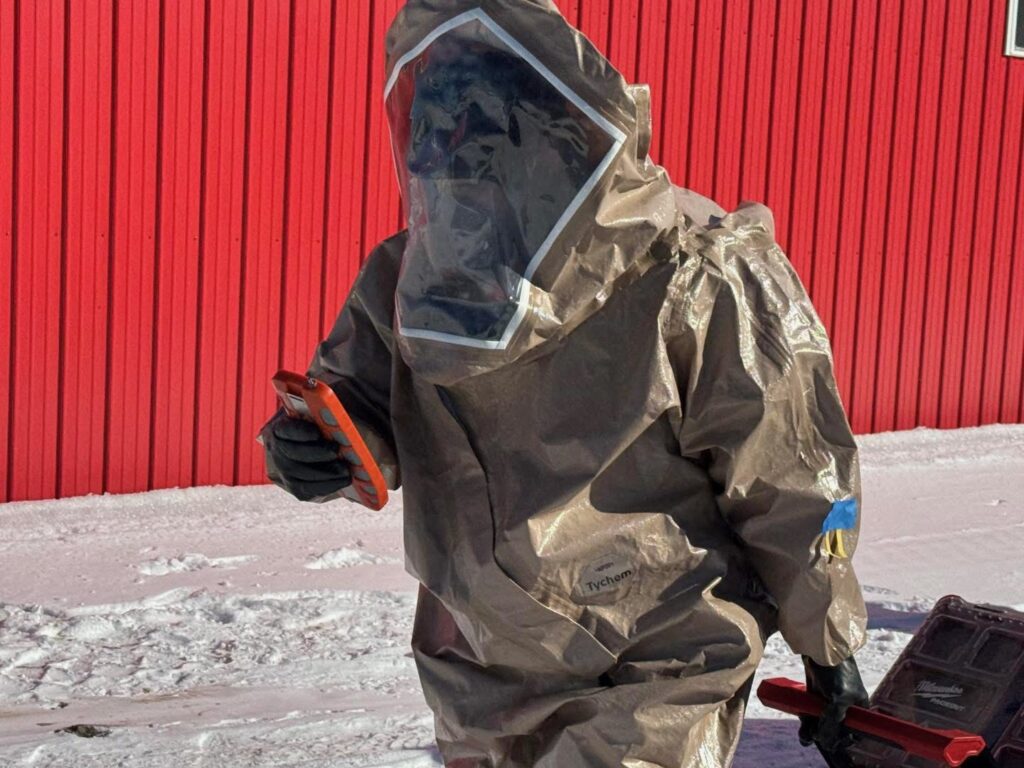
By Phil Ambrose, Battalion Chief (Ret.) and HazSim Founder
Your entry team is 30 feet inside a strip mall dry cleaner. The four-gas is showing 4% LEL and climbing. The PID just jumped from 47 to 112 ppm. The radiation monitor is clean. What does your crew do next?
If the answer is it depends on who’s holding the meter and how well and how often they’ve been trained. That’s a problem. And it’s the problem most hazmat training never actually solves, because most hazmat training never puts an instrument in every member’s hands with readings that change while they’re standing in the space trying to make a decision.
Last month I worked with a department in the Southeast that wanted to change that. They had 90 minutes of drill time, a mixed-experience roster, and a straightforward goal. Every person on the team would interpret dynamic readings in a realistic scenario before they went home. There would be no spectators.
Here’s how we did it.
The Setup
Reported unknown substance at a dry cleaner. Dispatch information was intentionally thin — odor complaint from adjacent tenant, one employee with a headache, no visible spill. Three instruments staged: four-gas (O2, LEL, CO, H2S), PID, and radiation monitor. Each member was assigned an instrument.
Scenario Briefing
Unit 4, Parkside strip mall — Golden Dragon Cleaners. Adjacent cell phone store reporting chemical smell through a shared wall. The size up is a single-story commercial, shared HVAC unknown, no placard, no MSDS on file, no inspection or pre-incident plan notes from dispatch.
First Entry Initial Readings
Twenty feet in, the instruments starts talking. The four-gas meter shows LEL at 4%, O2 at 20.7%, CO and H2S clean. The PID shows 47 ppm — elevated but could be perc. Radiation is clean.
Two Minutes After Entry
Two minutes later, LEL climbs from 4% to 16%, then 18%. PID spikes from 47 to 85, then to 112 ppm in 90 seconds. Rad is still clean. Two out of the three are escalating.
Readings progression:
4-Gas LEL: 4% → 15% → 19%
4-Gas O2: 20.7% → 20.5% → 20.4%
CO/H2S: 0 throughout
PID: 47 → 85 → 112 ppm
Radiation: Background throughout
Communication Goals
The training officers in charge of the evolutions are looking for communication between IC and interior that follows something like this.
Entry team leader: “Entry to Command — LEL at 15 and climbing, PID at 112 and climbing, rad is clean. Requesting guidance on action level. Holding at front counter.”
IC: “Is the PID still climbing or leveled off?”
The PID peaked at 112 then declined to 60. When the operator called back
Entry team: “PID trending down, now at 94.”
The IC continued the survey with a withdrawal trigger of 25% LEL or any H2S. This is a defensible decision based on real-time data.
The Hazard Determination
High PID, no H2S, no CO — volatile organic compound consistent with perc. The crew made a hazard determination from available data, communicated it clearly, and IC established action levels.
Four Reasons This Session Works
Three iterations in 90 minutes. Same setup with different substances and concentrations each time. This circumvents the “hey, what did you find?” talk between training crews.
- Every member got hands-on reps. All 12 held an instrument and read changing numbers.
- Dynamic readings forced real-time decisions by entry crew and IC.
- Three iterations. By the third rotation, response time on hazard ID dropped by half.
- Realistic scenario — a strip mall dry cleaner is the kind of call most departments will actually run.
Also Read: NFPA 1010 Changes the Game for Gas Detection Training
The NFPA 1010 standard calls for competency-based documentation — not seat time. This scenario with documented rotations and individual reps gives you that trail.
Staying Within Budget
The above training evolution does not require expensive or dangerous live agents for realism. Having access to a dry cleaner off hours is ideal, but the training can easily be held at the department’s training facility or station. A timer on your watch or phone and a simple script dictating when and by how much to change the meters’ readings is all that’s required for set up time and equipment.
FY27 budgets are being built now. AFG and SAFER both support training equipment. A program aligned with NFPA 1010 that delivers measurable competency outcomes is what grant reviewers want to see.
HazSim allows you to conduct realistic, repeatable training and record those training outcomes to meet NFPA 1010 and ISO requirements.
Need more plug-and-play training ideas for your team. Check out our Hazmat Drill Cards here.
Want to talk through a scenario for your department? Contact me at hazsim.com/contact or at [email protected].